A newsletter & community
for neurodivergent
businessgirlies.

about karina
panties, knives and sunflower seeds
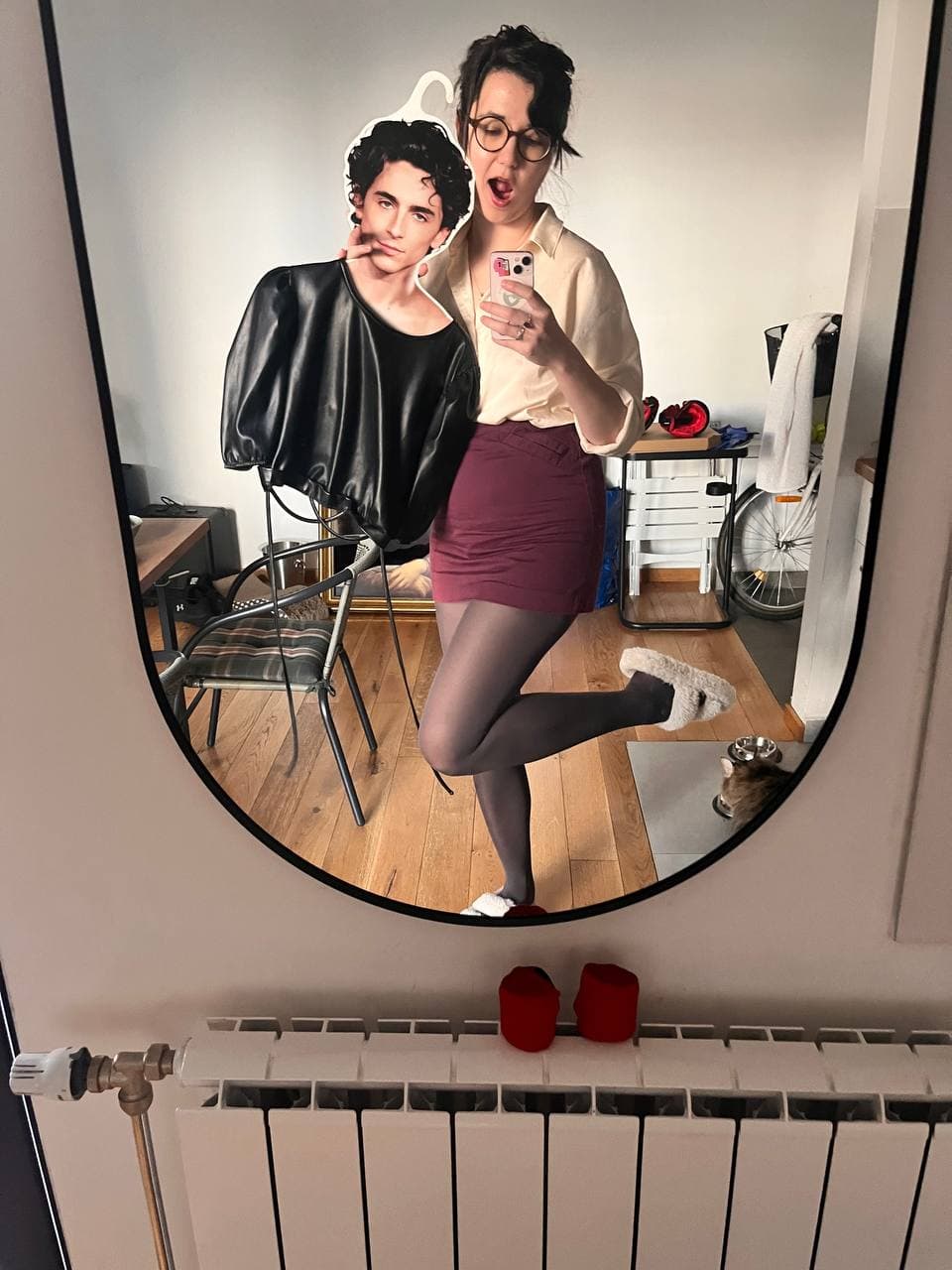
‘Check out my knife’ and ‘fancy some salty sunflower seeds?’ come up in conversation a lot, and so does the subject of panties. I’m certain being neurodivergent is the best thing there is, so I help late-diagnosed auDHD girlies build businesses that fit like a really good pair of panties – the money you want, the people you actually want to work with, the tasks you actually want to do. The vision I’m heading toward: 15,000 EUR a month, pink hair, and retreats for auDHD women entrepreneurs as an actual line of the business.
Diagnosed late with autism, ADHD and CPTSD, I turned out not to be broken – just speaking to the neurotypical world in a foreign language without knowing it was foreign.
If you want to connect or collaborate, email me at karushtova@gmail.com – I read English, Russian, Ukrainian, French and Serbian.
Karina Arushtova

letters from karina
6 August 2026
positivity, unfortunately
For more than half my life, I was against positivity. That was a mistake, and this letter is my way of admitting it. This isn’t an article about toxic positivity; it’s the opposite. My mind changed, and honestly, it annoys me. It’s the same kind of annoyance as when someone tells you to go outside, drink some water, and get some sleep. The advice sounds stupid, like trying to cover a huge hole with a tiny band-aid. But then you actually go outside, drink the water, and sleep, and it works. That’s the infuriating part: the basic things really do work. Why I didn’t trust it When I was a child, there were good emotions and bad emotions, and I didn’t get to decide which was which. Sadness was on the bad list, along with anger, rage, and being unhappy about anything. Having those feelings wasn’t allowed, and if I did, I was punished. My parents couldn’t manage their own feelings, and mine were more than they could handle. The result was the opposite of what anyone wanted. By my teens, nothing felt good enough, and everything seemed wrong. Then a classmate told me so. We were working on a project together. She brought me an idea, then a few more, and I answered with everything wrong with each of them. She got tired. Then she asked whether I had any ideas about how the thing could actually be done. I did not. That was the problem, and it had not occurred to me until she said it out loud. Some of it was about where I grew up, not just about me. I’m half Ukrainian and spent part of my childhood in Russia during the nineties. Negativity wasn’t a personal quirk there; it was how everyone spoke. Criticism was the usual way to talk about anything. Complaining was a way to connect, like how other people might ask about your weekend. Underneath it all was what Russians call хтонь : a heavy, hopeless murk that doesn’t really have an English equivalent. So I reached a conclusion, and it took twenty years to undo. All positivity is toxic. Not some of it. All of it. The logic went like this: ‘Real’ and ‘true’ were always linked to something sad. If something was difficult, dark, or disappointing, it was considered the truth. If something was good, you were seen as naive, being fooled, or not looking hard enough yet. In that setup, positivity wasn’t just irritating—it felt dishonest. It kept you from seeing what was actually in front of you. That’s why every piece of advice about optimism felt like a threat instead of a suggestion. Being told to look on the bright side felt like being told to shut down a feeling, just like when I was a child and certain feelings were declared unacceptable. What changed Therapy, first, over a long time. Slowly, it stopped being ‘everything is bad’ or ‘everything is fine’ and became a range with a great deal of room. Much of my reading of any situation turned out to be tilted before I had started looking. Where I stood had been a reaction. Nobody had ever decided it, including me. Then came ICF coach training, which is where it all came together for me. I mention ICF because ‘coach’ can mean almost anything these days. The International Coaching Federation has its own methodology, certification, and standards, and that’s the one I trained in. While you train, you also get coached yourself. And one of the things you are taught is to help clients say their goals in positive terms. Most people do not do this unprompted. They arrive with ‘I want to stop scrolling TikTok’, ‘I want to stop taking clients who drain me’, ‘I want to stop being tired by Wednesday’. It looks like nothing. A technique. Almost a formatting rule. It changed something anyway, because I saw how constantly I do it myself. How often I look at a thing I do not like, think ‘I wish it wasn’t like this’, and call that a goal. Then came the part that made acceptance possible. This kind of positivity doesn’t shut anything down. You can be a very positive person and still feel bad, sad, angry, or disappointed—those feelings don’t conflict. Nothing gets pushed aside. You feel what you feel, and then you decide what to do next. The objection I carried for twenty years turned out not to apply. Why it works, which is the annoying part Let me be clear about what is true. Working out what you do not like matters, and saying it out loud is a real stage. I am not asking anyone to skip it. But ‘I never want it to be like that again’ carries an enormous amount of feelings. Almost nobody reframes this on their own, and there’s a good reason for that. If you grew up in a crisis, nobody asked what was nice, pleasant, or good. That habit never developed. Girls are taught to be modest, not to ask, and to take what they’re given. And women often don’t say what they want, even when asked directly. What was nice, or pleasant, or good — the habit never got built. Girls get taught to be modest, not to ask, to take what they are given. And women very often do not say what they want, even when asked directly. So, in practice Take the sentence as it comes and write it down. Then, write a second sentence underneath that describes what you want instead—not just the absence of the first thing, but a real description of something you want. The test is simple: if the second sentence still includes words like no , not , without , less, or stop , it hasn’t changed yet. Keep going. Clients. ‘No more clients who message me at midnight.’ Reframe: I want clients who respect me and my time. Pricing. ‘I don’t want to feel awkward about my prices.’ Reframe: I want a month with six clients at 100 euros each, which will cover my rent and leave Fridays free. Now there is arithmetic to do rather than a feeling to manage. The week. ‘I don’t want to be exhausted by Thursday.’ Reframe: I want no more than two calls a day, mornings free, and one full day with nothing in it. That is a calendar rule. You can implement a calendar rule. Why our brains make this worse Someone replies to you with one word. Or takes two days to answer. Or says nothing at all. And you know immediately what it means. She is annoyed with you. She has changed her mind. You did something wrong. It does not feel like a guess — it feels like something you have found out. In auDHD spaces this is called rejection sensitive dysphoria: an intense, physically painful response to rejection, criticism or disapproval, real or assumed, far out of proportion to what actually happened. What it cost me ‘Neurodivergent people don’t have money.’ I hear this constantly from colleagues who also work with neurodivergent clients, and the conclusion is always the same: the product has to be cheap. I believed it too. When I started, a consultation cost ten euros. Doing them for nothing was under serious consideration, and I am extremely glad that did not happen. Since January last year, the price has been rising steadily. It is a hundred euros now — ten times what it started at. People bought at ten euros, and people buy at a hundred. The market did not change. What changed is that I could ask. That is what the positive version actually bought me: enough room to ask for ten times more. And the sentence itself is too vague to be either true or false. Who are we talking about? Only formally diagnosed people? Only people with a mental health diagnosis alongside it? What about everyone who has not told anyone, or does not yet know it about herself, including those working in tech and earning 4,000 euros a month or more? It is not a market observation. It is a mood with a demographic attached. It also keeps coming up with its own evidence. Price low, and you reach people who can only pay low. Then the low prices look like proof. This is one of the things ICF coaching does well: it takes a sentence that presents itself as a fact about the world, and finds out whether it is one. What I’m not saying Nobody should ignore how much pain there is in the world. There is a great deal of it; it is real, and pretending otherwise is its own kind of lying. What I am trying to do is not land in either extreme. There is an optimism that requires you to look away from suffering to keep working. And there is the version where you sink into the suffering until it is the only thing there is and you never allow yourself to be glad about anything. Both leave you seeing about the same, very small amount. And sometimes people are in a genuinely bad state. Depression, trauma, the serious versions of both. None of this applies there. That is what therapy is for, and this letter is not that. The last part I am happier now than I have been at any point in my life. It is an astonishing feeling, and I am not going to be embarrassed about it. Saying it out loud took a while — forming the sentence ‘I like everything about my life’ felt like promising too much to someone, probably to myself, and being held to it later. Jinxing it was a worry as well, and I do not believe in jinxes. I was not scared of being happy. I was scared of saying so. Which is the same fear as saying out loud what you want — and saying it is most of the work. Positivity, unfortunately.
read →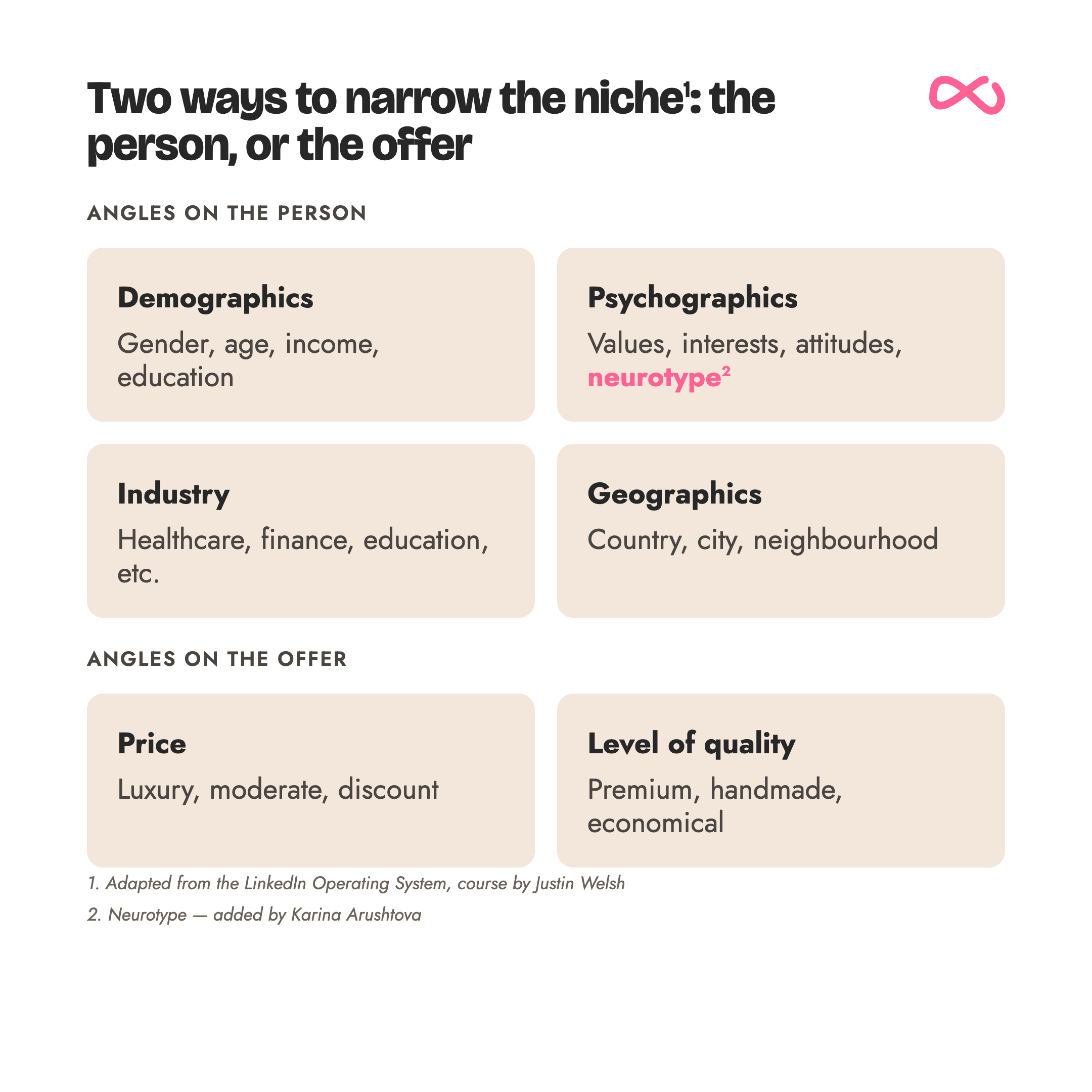
16 July 2026
start with who
Last time I said that choosing a niche isn’t cutting off an arm . You don’t lose the rest of yourself when you pick one. You decide which arm to extend first, and what to have it hold. So let’s say you’ve decided. You’re going to have a niche. Now what? This letter is the manual for what comes after. Let me start with a friend of yours. You probably already have one like her. She teaches English. That’s lovely, and the next time somebody mentions they’re looking for an English teacher, you’ll think of her. But imagine she isn’t a close friend – she’s an acquaintance of an acquaintance, a few steps removed. At that distance she becomes forgettable, because the only thing you know about her is that she teaches English. What level, what age, what anyone’s actually trying to achieve – you have no idea, and no particular reason to find out. Now imagine a different teacher. She teaches English to architecture students who’ve already been accepted to university, and whose first language isn’t English. Suddenly there’s a lot you know about her. Not all students – architecture students. Not all of them – the ones already enrolled. Not everyone – people for whom English is a second language. Architect, enrolled, English, non-native: four words that stick. And you’d remember her even if you barely knew her, because there’s so much that defines her. That’s the first thing a niche gives you: she’s memorable. She stands out in a crowd of teachers who all promise to teach anyone, of any age, for any reason. The second thing is money. Language lessons run from about €20 an hour to whatever the market will bear. Imagine you come across two teachers in a chat. One says ‘I’m an English teacher.’ The other says ‘I teach English to architecture students who’ve just been accepted, whose first language isn’t English.’ One charges €20, the other €150. Side by side, the more expensive one looks like a worse deal – nearly ten times the price for what appears to be the same thing. But the moment you can see that she’s built entirely around a specific person with specific needs, the number makes sense. And if you happen to be that person – an architect who just got in and needs the language and vocabulary of her field – she isn’t expensive. She’s exactly right. Here’s the part that feels wrong. When you don’t have clients yet, every instinct says: don’t choose. Take anyone. Widen everything, say yes to the whole world, and the clients will come. I understand it completely. It’s also what keeps you invisible. Narrowing is what lets people find you. Widening is what dissolves you into the background. A niche isn’t the goal, though. It’s a tool, and it has specific jobs. Once you have one, it tells you: what to make content about – you’re no longer looking at a blank page wondering what on earth to post; where to put that content – the niche names the actual rooms your people are already sitting in; who to gather around you – not an audience in the abstract, but the specific people who’ll go on to become clients; what to go deep on – one thing, properly, instead of everything, thinly. Everything that comes after this decision – the writing, the content, the where and the how – rests on it. That’s why it comes first. I’ve read the case for niching down as a solo business owner many times over. The most useful, most concrete tool I’ve found for actually doing it is the LinkedIn Operating System by Justin Welsh – a content creator who built a roughly two-million-dollar solo business, no ads, mostly on LinkedIn, and who teaches other solo business owners how he did it. A lot of his frameworks are genuinely good. Some of them need adapting for our brains – specifically, for auDHD wiring. So that’s what we’re going to do here: take his tool and calibrate it. Two things I like straight away. First, he has you do this before you write a single piece of content. Niche first, content plan second. Second, he doesn’t even say ‘niche’ – he says ‘sub-niche’, which narrows it by one turn. I love that. But look at where he arrives at who . Question three. I think who is question one. Here’s where the framework stopped working for me. His first question is: what’s a broad topic you know well? And almost none of the women I work with can answer it the way it’s meant. They say ‘I don’t know it well enough.’ Or ‘I’d need to research that properly first.’ Or the other version: ‘I do know it well, and I never want to touch it again.’ The question assumes an easy, ambient confidence that most of them have never been handed. Some of that is impostor syndrome, tangled up with the whole enormous subject of women and confidence – which deserves its own letter and will get one. For now it’s enough to say: she reaches question one and stalls. And then there’s my own version of the problem. For eight years, ‘what do you know well?’ was easy for me to answer. Learning experience design was my area of special interest, and I built a career around it. I worked as one. But when I sat down to choose a niche to build content and a business around, I realised something uncomfortable: I knew it well, and I didn’t want it. I didn’t want to research it, or read more about it, or go any deeper than I already had. It was true, and it was useless. Knowing the subject didn’t move me one step closer to the thing I actually wanted to build. When I first encountered this framework, my instinct was that I had to begin with what I already knew – that I had to earn the new thing by proving myself in the old one. That isn’t true. The framework asks what you know. It can’t hear that you want to move. The way out, funnily enough, came from the same course. Welsh lays out three ways to make content. Leading : you’re the expert, you know the material, and you bring people up to where you are – they trust you, and they buy from you. Discovering : you’re not the expert yet, but you want to be, so you read the research and share what you’re learning as you go. Reporting : you interview the people who already know. Discovering pulls knowledge from books and articles; reporting pulls it from people. And for an auDHD brain, discovering might be the whole point – the wanting to learn is the engine. When we hit a real special interest, the thing we actually want to burrow into, we’re unstoppable. Which means you can begin before you feel ready. You don’t have to be the expert to start. If feeling overwhelmed or anxious, try making your goal specific. Set a clear boundary, like ‘I’ll start after reading this book' or 'at fifty subscribers.' Most clients aren’t held back by being unready; they haven't defined what readiness means. Without a clear threshold, they stay in near-readiness, never starting. Setting a specific goal helps know when it's right to begin. So I’d rearrange Welsh’s questions. I’d ask first: who would you like to help? Start not with yourself, but with them. And not even with ‘them’ as an audience to sell to – forget selling for a minute – picture the actual people you’d like to help. Two reasons this works better as the opening question. One: you probably already know the answer. Most of us want to help a previous version of ourselves. (I build for women like me.) Two: impostor feelings attach themselves to self-description. The moment you have to describe yourself , and call yourself an expert, everything seizes up. Describe the people you want to help instead, and you can suddenly talk – easily, and for as long as anyone will listen. And there’s more than one door in. This isn’t a fixed one-two-three. Depending on the person, you might come in through: what has genuinely interested you for a long time? (Not what you know – what has stayed .) Or: what do you want to figure out? Wherever you start, you end up in the same room: who . Say you want to go deep on the restoration of paintings. Lovely – now, who for? Students learning to restore. People who watch restoration videos to fall asleep. People studying the history of the craft. Three completely different businesses, every one of them reached by asking who. Now you have your who . The next move is to make it more specific – which is not the same as narrower, and I’ll come back to that. There are two things you can sharpen: the person, or the offer. Sharpening the person, staying with hypothetical ‘teaching English’ example: gender → English for women. geography → English for people living in Milan. industry and demographics → English for architecture students. Sharpening the offer, same English: price → intensive one-to-one immersion at the luxury end; a €15 self-paced course anyone can afford at the other. level of quality → bespoke one-to-one coaching at the premium end; a small handmade cohort in the middle; a cheap, self-serve product at the economical end. Price and quality are easy to confuse, so here’s the split: price is what they pay; quality is what the thing actually is. They come apart in every direction. A one-woman ceramics studio can sell handmade work at a discount. A short course, built once and sold thousands of times, is cheap to make and can still sit at a moderate price. The interesting part is that you can combine these angles, and that’s where it gets good. My own niche is a stack of them: late-diagnosed auDHD women, already running a business, working toward earning at least €2,000 a month, reliably. That’s demographics, plus neurotype, plus a stage of business, plus a specific outcome. But – and this is the thing to hold on to while you stack – more words are not automatically better. Specific is the goal. Obscure is the failure. First, a warning. Every single time I’ve put that list of angles in front of a client, she’s read it as a questionnaire. Right – gender, age, income, education – and off she goes, dutifully filling in every box. Don’t. This isn’t a form to complete. Filling in every field is a different, later piece of work – it’s called an ideal customer profile, and it has its place. This list is a menu. You pick one angle to cut by. Maybe two. That’s the whole job. And second – the specific-versus-obscure thing. Alex, who writes Neurodivergently Yours , offers a sharp example of a niche gone wrong : a business coach for left-handed, vegan, ADHD-diagnosed anarchists who run Etsy shops. It’s a funny line, and the usual explanation is that it’s simply too narrow – too few people left to sustain a business. I don’t think that’s quite it. Look at my niche again: late-diagnosed, auDHD women in business, working toward a consistent €2,000 a month. That’s a lot of words too. More, arguably. The difference isn’t the number of words. It’s whether each word is doing anything. So here’s the test: take each word out, one at a time, and see whether anything changes. Remove ‘late-diagnosed’ from mine and the whole letter I’d write changes – the pain shifts, the tone shifts, the reader shifts. Remove ‘left-handed’ from Alex’s, and nothing moves at all. It was never telling you anything. If a word can come out and change nothing, it was never part of the niche. That’s the line between specific and obscure. So, to leave you with something solid – a few real sub-niches. All women. Most of them auDHD themselves. All already doing exactly this. (And notice these are sub -niches: each one narrowed a turn past the niche it sits inside.) Ellie Kay – ADHD and auDHD coach, neurodiversity speaker, management trainer. 25,700 followers on LinkedIn. Marie Helen Herbert – lived-experience auDHD; study-skills mentoring for ADHD, auDHD and dyslexia, alongside life, identity and menopause coaching for women. 10,602 followers. Rebecca McCash – auDHD founder, building the future neurodivergent people dream of. 2,769 followers. Tae Dawodu – neurodivergent career coach for women; helping you stop masking yourself into burnout at work. 2,497 followers. Dr Sharon Zivkovic – proudly auDHD; founder of the Centre for Autistic Social Entrepreneurship. Not one of them starts with ‘what do I know’. Every one of them starts with a who . You don’t have to know everything before you begin. You have to choose who you’re for.
read →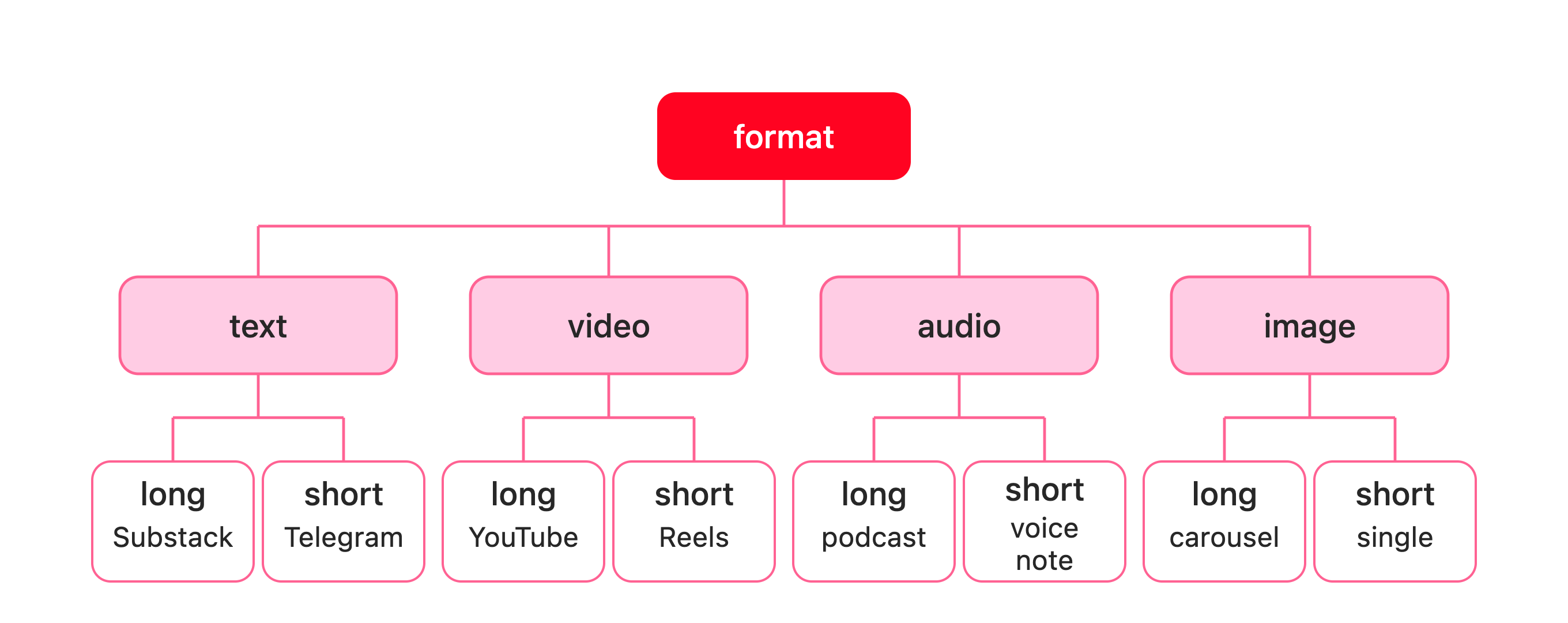
25 June 2026
choose the house last
You need to show up, do Reels, post Stories, and be visible. I hear it all the time from books and posts on marketing for solopreneurs like me. And every time, something inside clenches. Maybe you feel it too. For some of us, it’s plain revulsion. For others, it’s fear. And for a particular kind of us, it’s the very specific dread of being perceived at all – of putting your face into a square and pressing post and then living with the fact that it’s out there, being looked at, while you are over here, being you. But the question was never which platform . The question is, what would you actually want to make? Think of it as a question of where you live. You have been told to pack up your things and move into whichever house is fashionable this year. So you move in. You hate it. The light is wrong, the rooms don’t make sense, and you can never find the door. And then someone announces the next fashionable house, and off you go again. No wonder you keep fleeing in the night. So, you either end up with a desert of half-built profiles – an Instagram with nine posts, a Twitter you opened once with great intentions, a LinkedIn just sitting there going quietly grey. Or you have no profiles at all, only the small daily guilt-trip you administer to yourself, the one that goes: didn’t post again. I have to. I have to. Either way, the house wins, and you lose. So let’s not start with the house. Before we get anywhere near format, before we so much as glance at a platform, one question comes first: “Why do you want a platform?” Answer it in money, not in marketing. You want more income. You want it to arrive more evenly, so that opening your banking app no longer feels like a minor act of courage. You want better-fitting clients – the ones who already understand what you do before you’ve explained it. That’s the reason. Not ‘building a personal brand’. Now, the choosing. You’ll have heard the standard line: go where your audience is. But it’s half wrong for us. Our audience is scattered – she’s on TikTok and in her inbox and reading three newsletters and lurking on LinkedIn and nowhere in particular, all at once – so ‘where she is’ decides far less than you’re promised. You can start with two other things: • the format you’d actually want to make, • the interface you can bear to be inside. Format is finite. For all the noise, there are really only four shapes a thing can take: text, video, audio, image. And format, more than anything else, is what quietly points you toward a platform. Which brings me to the part almost nobody names, and the part that matters most for brains like ours. Sensory sensitivity does not politely stop at the edge of the physical world. We know it in fabric, lighting, and noise – the t-shirt label that ruins a day, the overhead cold white light that makes a room unbearable. But it’s there in the digital world too: the font a platform uses, whether it has a dark mode, and how many taps stand between you and a finished post. Whether the thing feels, under your hands, like somewhere you could move around with your eyes shut – or like a kitchen in which every drawer is in the wrong place. I’ll tell on myself. Start with Instagram. I do realise it’s helpful to plenty of creators – essential to tattoo artists, even. But. I. Just. Hate. This. App. To post a single story, I have to tap six times. That’s an interface problem, plain and simple: a room I can’t bear to be in. So every time I read “ just start consistently posting Instagram reels”, I want to bite someone’s head off. Now, TikTok – and this one’s the cleaner test, because I love TikTok. The app itself is a pleasure to use (so pleasurable in fact that I call it “my personal brand of heroin” after you-know-which book). For about a year, I tried to make things for it anyway and simply couldn’t – not for lack of trying, but because short-form video is the wrong shape for me to work in. Draining to make, not rewarding in the least. That’s a format problem, not a room one. Loving the app is not the same as loving what it asks you to build. I chose Substack because I wanted to do something long-form, something in text. That was my starting point: I knew I wanted to write and needed space for deeper, longer ideas. Once I realised that, it was much easier to pick a platform that fit. That’s the whole point, really. If the room repels you, no amount of discipline survives the lease. You will keep finding reasons not to go home. Start with one format and one platform. For example, you thrive in audio and absolutely don’t want to show your face. You can just post your voice. Think of it as moving into a new house: bring in your plants, lay down your rugs, make it comfortable and familiar. Let yourself feel at home there before you even think about moving anywhere else. Choose the house last. Choose yourself first. The consistency falls out of the fit. Karina Thanks for reading! Subscribe for free to receive new posts and support my work.
read →
11 June 2026
all of you, one niche
Pick a niche. If those words make something in you go quiet — or tense, or just tired — you’re not alone. I’ve heard it from so many women at the start of building something. I’ve felt it myself. The advice isn’t wrong. But it lands wrong. Because to a certain kind of brain — one that was never built for tunnel vision — it sounds like something is about to be amputated. There’s a word for the kind of person who has never been able to answer ‘what do you do?’ in one sentence. Multipotentialite 1 — someone with many genuine interests who moves between them not out of flakiness, but because each one is actually interesting. Not scattered. Reaching. For auDHD brains, this isn’t a personality quirk. It’s how the whole thing works. When something genuinely catches — really catches — the focus can be extraordinary. Hours disappear. A thread gets followed all the way to its end, and you come out the other side knowing things you didn’t know before. Then the thread runs out, and the brain finds another one and goes just as far. Different subject. The same real engagement. The interests cycle. They always have. The career that results makes complete internal sense and looks, from the outside, like a lot of things. This is the octopus. Eight arms, all moving, all reaching somewhere real. Image source And when someone says pick a niche , what the octopus hears is: pick one arm. The rest go. No wonder it lands badly. This isn’t fear of commitment. It’s the completely reasonable response of a creature that knows exactly what it is, being told to amputate seven-eighths of itself to be taken seriously. There’s a real reason people keep giving this advice, and it’s worth sitting with before dismissing it. A niche is what makes you findable. It’s what makes you stick in someone’s memory — and in someone’s head when they’re talking to exactly the person who needs you. A psychotherapist who works with anyone is easy to forget, hard to refer. A psychotherapist who works specifically with late-diagnosed auDHD women entrepreneurs? That catches. That stays. That gets mentioned. A niche is also what makes it possible to work with the people you actually want, doing the specific thing you’re genuinely good at, and to charge what that specific thing is worth. It’s not about shrinking. It’s about pointing. Here’s where the advice goes wrong: it applies the niche to the wrong thing. The niche doesn’t go on you. The octopus extends one arm — deliberately, clearly — and that arm points toward something specific. The rest stay exactly where they are. The creature reaching is still whole. [Illustration: the same octopus, one arm extended forward and pointing — the other seven arms still present, still going their own directions] Here’s what this looks like in practice. Kira Kuzmenko built a recruitment agency, a research centre, a jobs platform, several courses, and a salary analytics product. Different arms, different directions — and one obsession running underneath all of them: hiring, from every possible angle. The agency serves companies looking to hire. The platform serves candidates looking to be hired. The analytics tool speaks to anyone trying to understand what their work is actually worth on the market. The creature behind all of it is enormous, and that’s precisely why the expertise is real. None of those arms is doing the same thing. None of them is wasted. Anne-Laure Le Cunff is a researcher, a founder, a newsletter writer, and a book author. Her newsletter, Ness Labs, is for curious, knowledge-hungry people who want to think and work better. Her book, Tiny Experiments , is for people who want to stop overthinking their lives and start testing them instead. Her postdoctoral research at King’s College London lives in academic neuroscience. Three specific conversations, three specific arms. And none of them is all of her. My own path follows the same logic. University administration, learning experience design, building educational teams for tech companies, creating content for big brands. Both sides of the hiring table, more times than I can count. Freelanced, worked in-house, consulted. The path is not linear. It never was. But for this newsletter — for this particular arm — the pointing is specific. Late-diagnosed auDHD women building businesses. Women who want work that fits, clients they’ve actually chosen, income designed around a life that makes sense to them. The other seven haven’t gone anywhere. None of it’s wasted. It’s just not what this arm is pointing at. The niche is not another mask. It’s just where one arm is pointing. Karina If you’ve read this far, you’re probably my person. Subscribe — I write letters because I believe some things deserve to be sat with. 1 Emily Wapnick coined this term — her TED talk and her book are the place to start if this is the first time you’re hearing it.
read →28 May 2026
I'm not a businesswoman (or so I thought)
There is a post I read a few years ago about a woman who had a line in her internal self-description that went: I don’t run. Not a decision. Just: I am not someone who does that. The identity was fixed, and because it was fixed, it was true — the sentence held the whole story together, and pulling it out would have meant rebuilding more than a fitness habit. Hers was about running. Mine was: I’m not an entrepreneur. There is something particularly sticky about this kind of sentence for an auDHD brain. The autistic part tends to treat categories as fixed and final — you are, or you aren’t, no gradient. The ADHD part keeps pulling toward something new. The result is an identity you’ve quietly outgrown but that holds its shape, anchoring you somewhere you no longer fit. And the thing keeping mine in place was what I’d been shown. The word ‘entrepreneur’ still tends to conjure a specific kind of person — and it is rarely a woman. When a woman does appear, she is very serious. Capable, well-prepared, blazer, voice calibrated to take up exactly the right amount of room. I admire those women. I am not one of them. In tech, it was the founder type: cisgender men animated by growth as an end in itself. The definition of success was to eventually stop — exit the company, take the money, never have to work again. I could not find myself in this picture. Why would I want to stop? I spent most of my career on the side of creating educational content. There was a gap I couldn’t quite see across — between the meaning side and the money side, between making things and building something you could call a business. Not a contradiction. Just a distance I didn’t know how to close. The people on the business side weren’t thinking about what students were actually learning. They were thinking about revenue. Two streams running alongside each other, never quite meeting — and I spent a long time mistaking that distance for a contradiction. It wasn’t one. If you don’t formulate your own version of success, you tend to borrow one — from your parents, from the culture you grew up in, from the people who were loudest in the rooms you passed through. And then you work very hard toward a picture that was never actually yours. My version has a number and a shape. The number is not a billion — it is €10–15k a month, which is specific and enough and mine. The shape involves being able to grow the kind of nails that are technically incompatible with a full day of typing. Gelato on a Tuesday. Buying a ticket to see La Femme in Bologna without the decision being about whether you can afford it. None of this looked like the entrepreneur in my head. For a long time, I organised my sense of what was possible around a quiet hierarchy — and it didn’t require much active maintenance. Employment was real. Freelancing was precarious, but at least familiar. Business — actually owning something, calling it mine — sat so far outside the category of things that applied to me that I didn’t even need to refuse it. It simply wasn’t a question I was asking. As long as ‘entrepreneur’ meant that other person, I was quietly exempt from becoming one. At some point, it started to loosen. Through coaching, through reading, through research and other people’s stories and the slow accumulation of evidence that someone like me could actually do this — the identity became real. Not a revelation. Something that happened in layers, over years. And then, gradually, it became mine. Nails like small paintings, and all. I don’t run was true until the woman who wrote it started running. The identity followed the action. Not the other way round. The entrepreneur you were looking for doesn’t exist yet. She is waiting for you to make her. And she gets to look like you — which is to say, nothing like what you’ve been shown. When she does, someone else will see her and run the calculation differently. Karina If you’ve read this far, you’re probably my person. Subscribe — I write letters because I believe some things deserve to be sat with.
read →14 May 2026
I think you don't exist
A while back, I was being coached. The person coaching me was a woman from Pakistan. At some point in our session, I had this sudden, almost embarrassing realisation: I couldn’t fully believe she was real. Not her specifically — she was very much real, and very much present, asking me sharp questions. But this mental construct I’d been carrying since childhood had just shown up uninvited: the sense that people ‘from abroad’ are somehow not quite there. Not quite solid. Either fictional, or impossibly competent, or both. I grew up in Moscow. At some point in English class, our teacher gave us an assignment: write a letter to a pen pal from England. I wrote the letter — carefully, in my best handwriting, with my most earnest sentences. But even as I wrote it, something felt slightly unreal about the exercise. Were these people actually there? Did they have kitchens and arguments with their parents and favourite songs? Or were they more like a concept — people from England — existing in some abstract elsewhere? I’ve watched the same thing show up with clients. Women who speak fluent English, fluent Italian, who have genuinely brilliant careers — and still say, almost apologetically, ‘I don’t think working internationally is really realistic for me.’ Women who undersell their services to people far less talented, because some part of them still believes the world beyond their immediate context is populated by impossibly qualified people who would never pay for what they offer. Here’s what that session cracked open: there is no singular ‘abroad.’ No monolith of exceptional, unreachable people. Just people, in specific places, with specific contexts — and the gap between you and them is rarely what your brain tells you it is. This newsletter exists partly because of that realisation. My name is Karina — a late-diagnosed auDHD woman, an ICF-certified coach, and a business consultant. The women I work with have already made the leap — they’ve left employment, they have clients, and they’re working toward income that arrives consistently enough to build a life around. They don’t fit neatly into the ‘serious businesswoman in a blazer’ template, and they’re not trying to. Freedom matters to them. Genuinely interesting work matters to them. They’re figuring out how to build something that actually reflects who they are. Most business advice wasn’t built for someone who simultaneously craves a meticulously organised Notion system and wants to launch forty-three projects at once — and who has masked so effectively, for so long, that she’s lost track of what she actually wants underneath all that adaptation. What we’ll talk about here isn’t growth for its own sake. It’s about finding work that fits, clients you actually want, and building income around a life you’re designing — not somebody else’s template for what that should look like. Welcome. You exist. Karina If you’ve read this far, you’re probably my person. Subscribe — I write letters because I believe some things deserve to be sat with.
read →6 August 2026
positivity, unfortunately
For more than half my life, I was against positivity. That was a mistake, and this letter is my way of admitting it. This isn’t an article about toxic positivity; it’s the opposite. My mind changed, and honestly, it annoys me. It’s the same kind of annoyance as when someone tells you to go outside, drink some water, and get some sleep. The advice sounds stupid, like trying to cover a huge hole with a tiny band-aid. But then you actually go outside, drink the water, and sleep, and it works. That’s the infuriating part: the basic things really do work. Why I didn’t trust it When I was a child, there were good emotions and bad emotions, and I didn’t get to decide which was which. Sadness was on the bad list, along with anger, rage, and being unhappy about anything. Having those feelings wasn’t allowed, and if I did, I was punished. My parents couldn’t manage their own feelings, and mine were more than they could handle. The result was the opposite of what anyone wanted. By my teens, nothing felt good enough, and everything seemed wrong. Then a classmate told me so. We were working on a project together. She brought me an idea, then a few more, and I answered with everything wrong with each of them. She got tired. Then she asked whether I had any ideas about how the thing could actually be done. I did not. That was the problem, and it had not occurred to me until she said it out loud. Some of it was about where I grew up, not just about me. I’m half Ukrainian and spent part of my childhood in Russia during the nineties. Negativity wasn’t a personal quirk there; it was how everyone spoke. Criticism was the usual way to talk about anything. Complaining was a way to connect, like how other people might ask about your weekend. Underneath it all was what Russians call хтонь : a heavy, hopeless murk that doesn’t really have an English equivalent. So I reached a conclusion, and it took twenty years to undo. All positivity is toxic. Not some of it. All of it. The logic went like this: ‘Real’ and ‘true’ were always linked to something sad. If something was difficult, dark, or disappointing, it was considered the truth. If something was good, you were seen as naive, being fooled, or not looking hard enough yet. In that setup, positivity wasn’t just irritating—it felt dishonest. It kept you from seeing what was actually in front of you. That’s why every piece of advice about optimism felt like a threat instead of a suggestion. Being told to look on the bright side felt like being told to shut down a feeling, just like when I was a child and certain feelings were declared unacceptable. What changed Therapy, first, over a long time. Slowly, it stopped being ‘everything is bad’ or ‘everything is fine’ and became a range with a great deal of room. Much of my reading of any situation turned out to be tilted before I had started looking. Where I stood had been a reaction. Nobody had ever decided it, including me. Then came ICF coach training, which is where it all came together for me. I mention ICF because ‘coach’ can mean almost anything these days. The International Coaching Federation has its own methodology, certification, and standards, and that’s the one I trained in. While you train, you also get coached yourself. And one of the things you are taught is to help clients say their goals in positive terms. Most people do not do this unprompted. They arrive with ‘I want to stop scrolling TikTok’, ‘I want to stop taking clients who drain me’, ‘I want to stop being tired by Wednesday’. It looks like nothing. A technique. Almost a formatting rule. It changed something anyway, because I saw how constantly I do it myself. How often I look at a thing I do not like, think ‘I wish it wasn’t like this’, and call that a goal. Then came the part that made acceptance possible. This kind of positivity doesn’t shut anything down. You can be a very positive person and still feel bad, sad, angry, or disappointed—those feelings don’t conflict. Nothing gets pushed aside. You feel what you feel, and then you decide what to do next. The objection I carried for twenty years turned out not to apply. Why it works, which is the annoying part Let me be clear about what is true. Working out what you do not like matters, and saying it out loud is a real stage. I am not asking anyone to skip it. But ‘I never want it to be like that again’ carries an enormous amount of feelings. Almost nobody reframes this on their own, and there’s a good reason for that. If you grew up in a crisis, nobody asked what was nice, pleasant, or good. That habit never developed. Girls are taught to be modest, not to ask, and to take what they’re given. And women often don’t say what they want, even when asked directly. What was nice, or pleasant, or good — the habit never got built. Girls get taught to be modest, not to ask, to take what they are given. And women very often do not say what they want, even when asked directly. So, in practice Take the sentence as it comes and write it down. Then, write a second sentence underneath that describes what you want instead—not just the absence of the first thing, but a real description of something you want. The test is simple: if the second sentence still includes words like no , not , without , less, or stop , it hasn’t changed yet. Keep going. Clients. ‘No more clients who message me at midnight.’ Reframe: I want clients who respect me and my time. Pricing. ‘I don’t want to feel awkward about my prices.’ Reframe: I want a month with six clients at 100 euros each, which will cover my rent and leave Fridays free. Now there is arithmetic to do rather than a feeling to manage. The week. ‘I don’t want to be exhausted by Thursday.’ Reframe: I want no more than two calls a day, mornings free, and one full day with nothing in it. That is a calendar rule. You can implement a calendar rule. Why our brains make this worse Someone replies to you with one word. Or takes two days to answer. Or says nothing at all. And you know immediately what it means. She is annoyed with you. She has changed her mind. You did something wrong. It does not feel like a guess — it feels like something you have found out. In auDHD spaces this is called rejection sensitive dysphoria: an intense, physically painful response to rejection, criticism or disapproval, real or assumed, far out of proportion to what actually happened. What it cost me ‘Neurodivergent people don’t have money.’ I hear this constantly from colleagues who also work with neurodivergent clients, and the conclusion is always the same: the product has to be cheap. I believed it too. When I started, a consultation cost ten euros. Doing them for nothing was under serious consideration, and I am extremely glad that did not happen. Since January last year, the price has been rising steadily. It is a hundred euros now — ten times what it started at. People bought at ten euros, and people buy at a hundred. The market did not change. What changed is that I could ask. That is what the positive version actually bought me: enough room to ask for ten times more. And the sentence itself is too vague to be either true or false. Who are we talking about? Only formally diagnosed people? Only people with a mental health diagnosis alongside it? What about everyone who has not told anyone, or does not yet know it about herself, including those working in tech and earning 4,000 euros a month or more? It is not a market observation. It is a mood with a demographic attached. It also keeps coming up with its own evidence. Price low, and you reach people who can only pay low. Then the low prices look like proof. This is one of the things ICF coaching does well: it takes a sentence that presents itself as a fact about the world, and finds out whether it is one. What I’m not saying Nobody should ignore how much pain there is in the world. There is a great deal of it; it is real, and pretending otherwise is its own kind of lying. What I am trying to do is not land in either extreme. There is an optimism that requires you to look away from suffering to keep working. And there is the version where you sink into the suffering until it is the only thing there is and you never allow yourself to be glad about anything. Both leave you seeing about the same, very small amount. And sometimes people are in a genuinely bad state. Depression, trauma, the serious versions of both. None of this applies there. That is what therapy is for, and this letter is not that. The last part I am happier now than I have been at any point in my life. It is an astonishing feeling, and I am not going to be embarrassed about it. Saying it out loud took a while — forming the sentence ‘I like everything about my life’ felt like promising too much to someone, probably to myself, and being held to it later. Jinxing it was a worry as well, and I do not believe in jinxes. I was not scared of being happy. I was scared of saying so. Which is the same fear as saying out loud what you want — and saying it is most of the work. Positivity, unfortunately.
read →16 July 2026
start with who
Last time I said that choosing a niche isn’t cutting off an arm . You don’t lose the rest of yourself when you pick one. You decide which arm to extend first, and what to have it hold. So let’s say you’ve decided. You’re going to have a niche. Now what? This letter is the manual for what comes after. Let me start with a friend of yours. You probably already have one like her. She teaches English. That’s lovely, and the next time somebody mentions they’re looking for an English teacher, you’ll think of her. But imagine she isn’t a close friend – she’s an acquaintance of an acquaintance, a few steps removed. At that distance she becomes forgettable, because the only thing you know about her is that she teaches English. What level, what age, what anyone’s actually trying to achieve – you have no idea, and no particular reason to find out. Now imagine a different teacher. She teaches English to architecture students who’ve already been accepted to university, and whose first language isn’t English. Suddenly there’s a lot you know about her. Not all students – architecture students. Not all of them – the ones already enrolled. Not everyone – people for whom English is a second language. Architect, enrolled, English, non-native: four words that stick. And you’d remember her even if you barely knew her, because there’s so much that defines her. That’s the first thing a niche gives you: she’s memorable. She stands out in a crowd of teachers who all promise to teach anyone, of any age, for any reason. The second thing is money. Language lessons run from about €20 an hour to whatever the market will bear. Imagine you come across two teachers in a chat. One says ‘I’m an English teacher.’ The other says ‘I teach English to architecture students who’ve just been accepted, whose first language isn’t English.’ One charges €20, the other €150. Side by side, the more expensive one looks like a worse deal – nearly ten times the price for what appears to be the same thing. But the moment you can see that she’s built entirely around a specific person with specific needs, the number makes sense. And if you happen to be that person – an architect who just got in and needs the language and vocabulary of her field – she isn’t expensive. She’s exactly right. Here’s the part that feels wrong. When you don’t have clients yet, every instinct says: don’t choose. Take anyone. Widen everything, say yes to the whole world, and the clients will come. I understand it completely. It’s also what keeps you invisible. Narrowing is what lets people find you. Widening is what dissolves you into the background. A niche isn’t the goal, though. It’s a tool, and it has specific jobs. Once you have one, it tells you: what to make content about – you’re no longer looking at a blank page wondering what on earth to post; where to put that content – the niche names the actual rooms your people are already sitting in; who to gather around you – not an audience in the abstract, but the specific people who’ll go on to become clients; what to go deep on – one thing, properly, instead of everything, thinly. Everything that comes after this decision – the writing, the content, the where and the how – rests on it. That’s why it comes first. I’ve read the case for niching down as a solo business owner many times over. The most useful, most concrete tool I’ve found for actually doing it is the LinkedIn Operating System by Justin Welsh – a content creator who built a roughly two-million-dollar solo business, no ads, mostly on LinkedIn, and who teaches other solo business owners how he did it. A lot of his frameworks are genuinely good. Some of them need adapting for our brains – specifically, for auDHD wiring. So that’s what we’re going to do here: take his tool and calibrate it. Two things I like straight away. First, he has you do this before you write a single piece of content. Niche first, content plan second. Second, he doesn’t even say ‘niche’ – he says ‘sub-niche’, which narrows it by one turn. I love that. But look at where he arrives at who . Question three. I think who is question one. Here’s where the framework stopped working for me. His first question is: what’s a broad topic you know well? And almost none of the women I work with can answer it the way it’s meant. They say ‘I don’t know it well enough.’ Or ‘I’d need to research that properly first.’ Or the other version: ‘I do know it well, and I never want to touch it again.’ The question assumes an easy, ambient confidence that most of them have never been handed. Some of that is impostor syndrome, tangled up with the whole enormous subject of women and confidence – which deserves its own letter and will get one. For now it’s enough to say: she reaches question one and stalls. And then there’s my own version of the problem. For eight years, ‘what do you know well?’ was easy for me to answer. Learning experience design was my area of special interest, and I built a career around it. I worked as one. But when I sat down to choose a niche to build content and a business around, I realised something uncomfortable: I knew it well, and I didn’t want it. I didn’t want to research it, or read more about it, or go any deeper than I already had. It was true, and it was useless. Knowing the subject didn’t move me one step closer to the thing I actually wanted to build. When I first encountered this framework, my instinct was that I had to begin with what I already knew – that I had to earn the new thing by proving myself in the old one. That isn’t true. The framework asks what you know. It can’t hear that you want to move. The way out, funnily enough, came from the same course. Welsh lays out three ways to make content. Leading : you’re the expert, you know the material, and you bring people up to where you are – they trust you, and they buy from you. Discovering : you’re not the expert yet, but you want to be, so you read the research and share what you’re learning as you go. Reporting : you interview the people who already know. Discovering pulls knowledge from books and articles; reporting pulls it from people. And for an auDHD brain, discovering might be the whole point – the wanting to learn is the engine. When we hit a real special interest, the thing we actually want to burrow into, we’re unstoppable. Which means you can begin before you feel ready. You don’t have to be the expert to start. If feeling overwhelmed or anxious, try making your goal specific. Set a clear boundary, like ‘I’ll start after reading this book' or 'at fifty subscribers.' Most clients aren’t held back by being unready; they haven't defined what readiness means. Without a clear threshold, they stay in near-readiness, never starting. Setting a specific goal helps know when it's right to begin. So I’d rearrange Welsh’s questions. I’d ask first: who would you like to help? Start not with yourself, but with them. And not even with ‘them’ as an audience to sell to – forget selling for a minute – picture the actual people you’d like to help. Two reasons this works better as the opening question. One: you probably already know the answer. Most of us want to help a previous version of ourselves. (I build for women like me.) Two: impostor feelings attach themselves to self-description. The moment you have to describe yourself , and call yourself an expert, everything seizes up. Describe the people you want to help instead, and you can suddenly talk – easily, and for as long as anyone will listen. And there’s more than one door in. This isn’t a fixed one-two-three. Depending on the person, you might come in through: what has genuinely interested you for a long time? (Not what you know – what has stayed .) Or: what do you want to figure out? Wherever you start, you end up in the same room: who . Say you want to go deep on the restoration of paintings. Lovely – now, who for? Students learning to restore. People who watch restoration videos to fall asleep. People studying the history of the craft. Three completely different businesses, every one of them reached by asking who. Now you have your who . The next move is to make it more specific – which is not the same as narrower, and I’ll come back to that. There are two things you can sharpen: the person, or the offer. Sharpening the person, staying with hypothetical ‘teaching English’ example: gender → English for women. geography → English for people living in Milan. industry and demographics → English for architecture students. Sharpening the offer, same English: price → intensive one-to-one immersion at the luxury end; a €15 self-paced course anyone can afford at the other. level of quality → bespoke one-to-one coaching at the premium end; a small handmade cohort in the middle; a cheap, self-serve product at the economical end. Price and quality are easy to confuse, so here’s the split: price is what they pay; quality is what the thing actually is. They come apart in every direction. A one-woman ceramics studio can sell handmade work at a discount. A short course, built once and sold thousands of times, is cheap to make and can still sit at a moderate price. The interesting part is that you can combine these angles, and that’s where it gets good. My own niche is a stack of them: late-diagnosed auDHD women, already running a business, working toward earning at least €2,000 a month, reliably. That’s demographics, plus neurotype, plus a stage of business, plus a specific outcome. But – and this is the thing to hold on to while you stack – more words are not automatically better. Specific is the goal. Obscure is the failure. First, a warning. Every single time I’ve put that list of angles in front of a client, she’s read it as a questionnaire. Right – gender, age, income, education – and off she goes, dutifully filling in every box. Don’t. This isn’t a form to complete. Filling in every field is a different, later piece of work – it’s called an ideal customer profile, and it has its place. This list is a menu. You pick one angle to cut by. Maybe two. That’s the whole job. And second – the specific-versus-obscure thing. Alex, who writes Neurodivergently Yours , offers a sharp example of a niche gone wrong : a business coach for left-handed, vegan, ADHD-diagnosed anarchists who run Etsy shops. It’s a funny line, and the usual explanation is that it’s simply too narrow – too few people left to sustain a business. I don’t think that’s quite it. Look at my niche again: late-diagnosed, auDHD women in business, working toward a consistent €2,000 a month. That’s a lot of words too. More, arguably. The difference isn’t the number of words. It’s whether each word is doing anything. So here’s the test: take each word out, one at a time, and see whether anything changes. Remove ‘late-diagnosed’ from mine and the whole letter I’d write changes – the pain shifts, the tone shifts, the reader shifts. Remove ‘left-handed’ from Alex’s, and nothing moves at all. It was never telling you anything. If a word can come out and change nothing, it was never part of the niche. That’s the line between specific and obscure. So, to leave you with something solid – a few real sub-niches. All women. Most of them auDHD themselves. All already doing exactly this. (And notice these are sub -niches: each one narrowed a turn past the niche it sits inside.) Ellie Kay – ADHD and auDHD coach, neurodiversity speaker, management trainer. 25,700 followers on LinkedIn. Marie Helen Herbert – lived-experience auDHD; study-skills mentoring for ADHD, auDHD and dyslexia, alongside life, identity and menopause coaching for women. 10,602 followers. Rebecca McCash – auDHD founder, building the future neurodivergent people dream of. 2,769 followers. Tae Dawodu – neurodivergent career coach for women; helping you stop masking yourself into burnout at work. 2,497 followers. Dr Sharon Zivkovic – proudly auDHD; founder of the Centre for Autistic Social Entrepreneurship. Not one of them starts with ‘what do I know’. Every one of them starts with a who . You don’t have to know everything before you begin. You have to choose who you’re for.
read →25 June 2026
choose the house last
You need to show up, do Reels, post Stories, and be visible. I hear it all the time from books and posts on marketing for solopreneurs like me. And every time, something inside clenches. Maybe you feel it too. For some of us, it’s plain revulsion. For others, it’s fear. And for a particular kind of us, it’s the very specific dread of being perceived at all – of putting your face into a square and pressing post and then living with the fact that it’s out there, being looked at, while you are over here, being you. But the question was never which platform . The question is, what would you actually want to make? Think of it as a question of where you live. You have been told to pack up your things and move into whichever house is fashionable this year. So you move in. You hate it. The light is wrong, the rooms don’t make sense, and you can never find the door. And then someone announces the next fashionable house, and off you go again. No wonder you keep fleeing in the night. So, you either end up with a desert of half-built profiles – an Instagram with nine posts, a Twitter you opened once with great intentions, a LinkedIn just sitting there going quietly grey. Or you have no profiles at all, only the small daily guilt-trip you administer to yourself, the one that goes: didn’t post again. I have to. I have to. Either way, the house wins, and you lose. So let’s not start with the house. Before we get anywhere near format, before we so much as glance at a platform, one question comes first: “Why do you want a platform?” Answer it in money, not in marketing. You want more income. You want it to arrive more evenly, so that opening your banking app no longer feels like a minor act of courage. You want better-fitting clients – the ones who already understand what you do before you’ve explained it. That’s the reason. Not ‘building a personal brand’. Now, the choosing. You’ll have heard the standard line: go where your audience is. But it’s half wrong for us. Our audience is scattered – she’s on TikTok and in her inbox and reading three newsletters and lurking on LinkedIn and nowhere in particular, all at once – so ‘where she is’ decides far less than you’re promised. You can start with two other things: • the format you’d actually want to make, • the interface you can bear to be inside. Format is finite. For all the noise, there are really only four shapes a thing can take: text, video, audio, image. And format, more than anything else, is what quietly points you toward a platform. Which brings me to the part almost nobody names, and the part that matters most for brains like ours. Sensory sensitivity does not politely stop at the edge of the physical world. We know it in fabric, lighting, and noise – the t-shirt label that ruins a day, the overhead cold white light that makes a room unbearable. But it’s there in the digital world too: the font a platform uses, whether it has a dark mode, and how many taps stand between you and a finished post. Whether the thing feels, under your hands, like somewhere you could move around with your eyes shut – or like a kitchen in which every drawer is in the wrong place. I’ll tell on myself. Start with Instagram. I do realise it’s helpful to plenty of creators – essential to tattoo artists, even. But. I. Just. Hate. This. App. To post a single story, I have to tap six times. That’s an interface problem, plain and simple: a room I can’t bear to be in. So every time I read “ just start consistently posting Instagram reels”, I want to bite someone’s head off. Now, TikTok – and this one’s the cleaner test, because I love TikTok. The app itself is a pleasure to use (so pleasurable in fact that I call it “my personal brand of heroin” after you-know-which book). For about a year, I tried to make things for it anyway and simply couldn’t – not for lack of trying, but because short-form video is the wrong shape for me to work in. Draining to make, not rewarding in the least. That’s a format problem, not a room one. Loving the app is not the same as loving what it asks you to build. I chose Substack because I wanted to do something long-form, something in text. That was my starting point: I knew I wanted to write and needed space for deeper, longer ideas. Once I realised that, it was much easier to pick a platform that fit. That’s the whole point, really. If the room repels you, no amount of discipline survives the lease. You will keep finding reasons not to go home. Start with one format and one platform. For example, you thrive in audio and absolutely don’t want to show your face. You can just post your voice. Think of it as moving into a new house: bring in your plants, lay down your rugs, make it comfortable and familiar. Let yourself feel at home there before you even think about moving anywhere else. Choose the house last. Choose yourself first. The consistency falls out of the fit. Karina Thanks for reading! Subscribe for free to receive new posts and support my work.
read →11 June 2026
all of you, one niche
Pick a niche. If those words make something in you go quiet — or tense, or just tired — you’re not alone. I’ve heard it from so many women at the start of building something. I’ve felt it myself. The advice isn’t wrong. But it lands wrong. Because to a certain kind of brain — one that was never built for tunnel vision — it sounds like something is about to be amputated. There’s a word for the kind of person who has never been able to answer ‘what do you do?’ in one sentence. Multipotentialite 1 — someone with many genuine interests who moves between them not out of flakiness, but because each one is actually interesting. Not scattered. Reaching. For auDHD brains, this isn’t a personality quirk. It’s how the whole thing works. When something genuinely catches — really catches — the focus can be extraordinary. Hours disappear. A thread gets followed all the way to its end, and you come out the other side knowing things you didn’t know before. Then the thread runs out, and the brain finds another one and goes just as far. Different subject. The same real engagement. The interests cycle. They always have. The career that results makes complete internal sense and looks, from the outside, like a lot of things. This is the octopus. Eight arms, all moving, all reaching somewhere real. Image source And when someone says pick a niche , what the octopus hears is: pick one arm. The rest go. No wonder it lands badly. This isn’t fear of commitment. It’s the completely reasonable response of a creature that knows exactly what it is, being told to amputate seven-eighths of itself to be taken seriously. There’s a real reason people keep giving this advice, and it’s worth sitting with before dismissing it. A niche is what makes you findable. It’s what makes you stick in someone’s memory — and in someone’s head when they’re talking to exactly the person who needs you. A psychotherapist who works with anyone is easy to forget, hard to refer. A psychotherapist who works specifically with late-diagnosed auDHD women entrepreneurs? That catches. That stays. That gets mentioned. A niche is also what makes it possible to work with the people you actually want, doing the specific thing you’re genuinely good at, and to charge what that specific thing is worth. It’s not about shrinking. It’s about pointing. Here’s where the advice goes wrong: it applies the niche to the wrong thing. The niche doesn’t go on you. The octopus extends one arm — deliberately, clearly — and that arm points toward something specific. The rest stay exactly where they are. The creature reaching is still whole. [Illustration: the same octopus, one arm extended forward and pointing — the other seven arms still present, still going their own directions] Here’s what this looks like in practice. Kira Kuzmenko built a recruitment agency, a research centre, a jobs platform, several courses, and a salary analytics product. Different arms, different directions — and one obsession running underneath all of them: hiring, from every possible angle. The agency serves companies looking to hire. The platform serves candidates looking to be hired. The analytics tool speaks to anyone trying to understand what their work is actually worth on the market. The creature behind all of it is enormous, and that’s precisely why the expertise is real. None of those arms is doing the same thing. None of them is wasted. Anne-Laure Le Cunff is a researcher, a founder, a newsletter writer, and a book author. Her newsletter, Ness Labs, is for curious, knowledge-hungry people who want to think and work better. Her book, Tiny Experiments , is for people who want to stop overthinking their lives and start testing them instead. Her postdoctoral research at King’s College London lives in academic neuroscience. Three specific conversations, three specific arms. And none of them is all of her. My own path follows the same logic. University administration, learning experience design, building educational teams for tech companies, creating content for big brands. Both sides of the hiring table, more times than I can count. Freelanced, worked in-house, consulted. The path is not linear. It never was. But for this newsletter — for this particular arm — the pointing is specific. Late-diagnosed auDHD women building businesses. Women who want work that fits, clients they’ve actually chosen, income designed around a life that makes sense to them. The other seven haven’t gone anywhere. None of it’s wasted. It’s just not what this arm is pointing at. The niche is not another mask. It’s just where one arm is pointing. Karina If you’ve read this far, you’re probably my person. Subscribe — I write letters because I believe some things deserve to be sat with. 1 Emily Wapnick coined this term — her TED talk and her book are the place to start if this is the first time you’re hearing it.
read →28 May 2026
I'm not a businesswoman (or so I thought)
There is a post I read a few years ago about a woman who had a line in her internal self-description that went: I don’t run. Not a decision. Just: I am not someone who does that. The identity was fixed, and because it was fixed, it was true — the sentence held the whole story together, and pulling it out would have meant rebuilding more than a fitness habit. Hers was about running. Mine was: I’m not an entrepreneur. There is something particularly sticky about this kind of sentence for an auDHD brain. The autistic part tends to treat categories as fixed and final — you are, or you aren’t, no gradient. The ADHD part keeps pulling toward something new. The result is an identity you’ve quietly outgrown but that holds its shape, anchoring you somewhere you no longer fit. And the thing keeping mine in place was what I’d been shown. The word ‘entrepreneur’ still tends to conjure a specific kind of person — and it is rarely a woman. When a woman does appear, she is very serious. Capable, well-prepared, blazer, voice calibrated to take up exactly the right amount of room. I admire those women. I am not one of them. In tech, it was the founder type: cisgender men animated by growth as an end in itself. The definition of success was to eventually stop — exit the company, take the money, never have to work again. I could not find myself in this picture. Why would I want to stop? I spent most of my career on the side of creating educational content. There was a gap I couldn’t quite see across — between the meaning side and the money side, between making things and building something you could call a business. Not a contradiction. Just a distance I didn’t know how to close. The people on the business side weren’t thinking about what students were actually learning. They were thinking about revenue. Two streams running alongside each other, never quite meeting — and I spent a long time mistaking that distance for a contradiction. It wasn’t one. If you don’t formulate your own version of success, you tend to borrow one — from your parents, from the culture you grew up in, from the people who were loudest in the rooms you passed through. And then you work very hard toward a picture that was never actually yours. My version has a number and a shape. The number is not a billion — it is €10–15k a month, which is specific and enough and mine. The shape involves being able to grow the kind of nails that are technically incompatible with a full day of typing. Gelato on a Tuesday. Buying a ticket to see La Femme in Bologna without the decision being about whether you can afford it. None of this looked like the entrepreneur in my head. For a long time, I organised my sense of what was possible around a quiet hierarchy — and it didn’t require much active maintenance. Employment was real. Freelancing was precarious, but at least familiar. Business — actually owning something, calling it mine — sat so far outside the category of things that applied to me that I didn’t even need to refuse it. It simply wasn’t a question I was asking. As long as ‘entrepreneur’ meant that other person, I was quietly exempt from becoming one. At some point, it started to loosen. Through coaching, through reading, through research and other people’s stories and the slow accumulation of evidence that someone like me could actually do this — the identity became real. Not a revelation. Something that happened in layers, over years. And then, gradually, it became mine. Nails like small paintings, and all. I don’t run was true until the woman who wrote it started running. The identity followed the action. Not the other way round. The entrepreneur you were looking for doesn’t exist yet. She is waiting for you to make her. And she gets to look like you — which is to say, nothing like what you’ve been shown. When she does, someone else will see her and run the calculation differently. Karina If you’ve read this far, you’re probably my person. Subscribe — I write letters because I believe some things deserve to be sat with.
read →14 May 2026
I think you don't exist
A while back, I was being coached. The person coaching me was a woman from Pakistan. At some point in our session, I had this sudden, almost embarrassing realisation: I couldn’t fully believe she was real. Not her specifically — she was very much real, and very much present, asking me sharp questions. But this mental construct I’d been carrying since childhood had just shown up uninvited: the sense that people ‘from abroad’ are somehow not quite there. Not quite solid. Either fictional, or impossibly competent, or both. I grew up in Moscow. At some point in English class, our teacher gave us an assignment: write a letter to a pen pal from England. I wrote the letter — carefully, in my best handwriting, with my most earnest sentences. But even as I wrote it, something felt slightly unreal about the exercise. Were these people actually there? Did they have kitchens and arguments with their parents and favourite songs? Or were they more like a concept — people from England — existing in some abstract elsewhere? I’ve watched the same thing show up with clients. Women who speak fluent English, fluent Italian, who have genuinely brilliant careers — and still say, almost apologetically, ‘I don’t think working internationally is really realistic for me.’ Women who undersell their services to people far less talented, because some part of them still believes the world beyond their immediate context is populated by impossibly qualified people who would never pay for what they offer. Here’s what that session cracked open: there is no singular ‘abroad.’ No monolith of exceptional, unreachable people. Just people, in specific places, with specific contexts — and the gap between you and them is rarely what your brain tells you it is. This newsletter exists partly because of that realisation. My name is Karina — a late-diagnosed auDHD woman, an ICF-certified coach, and a business consultant. The women I work with have already made the leap — they’ve left employment, they have clients, and they’re working toward income that arrives consistently enough to build a life around. They don’t fit neatly into the ‘serious businesswoman in a blazer’ template, and they’re not trying to. Freedom matters to them. Genuinely interesting work matters to them. They’re figuring out how to build something that actually reflects who they are. Most business advice wasn’t built for someone who simultaneously craves a meticulously organised Notion system and wants to launch forty-three projects at once — and who has masked so effectively, for so long, that she’s lost track of what she actually wants underneath all that adaptation. What we’ll talk about here isn’t growth for its own sake. It’s about finding work that fits, clients you actually want, and building income around a life you’re designing — not somebody else’s template for what that should look like. Welcome. You exist. Karina If you’ve read this far, you’re probably my person. Subscribe — I write letters because I believe some things deserve to be sat with.
read →